Dr. Güneş Taylor presents a CRS Special Seminar
Understanding how the ovary is formed, maintained, and ultimately depleted is central to reproductive biology and female health. In her special seminar on January 13, 2026, titled “Specification and Activation of Pre-granulosa Cells within the Vertebrate Ovary,” Dr. Güneş Taylor presented a compelling overview of how a specialized somatic cell population, pre-granulosa cells, is specified during development and later activated to regulate the lifespan of the ovarian reserve. 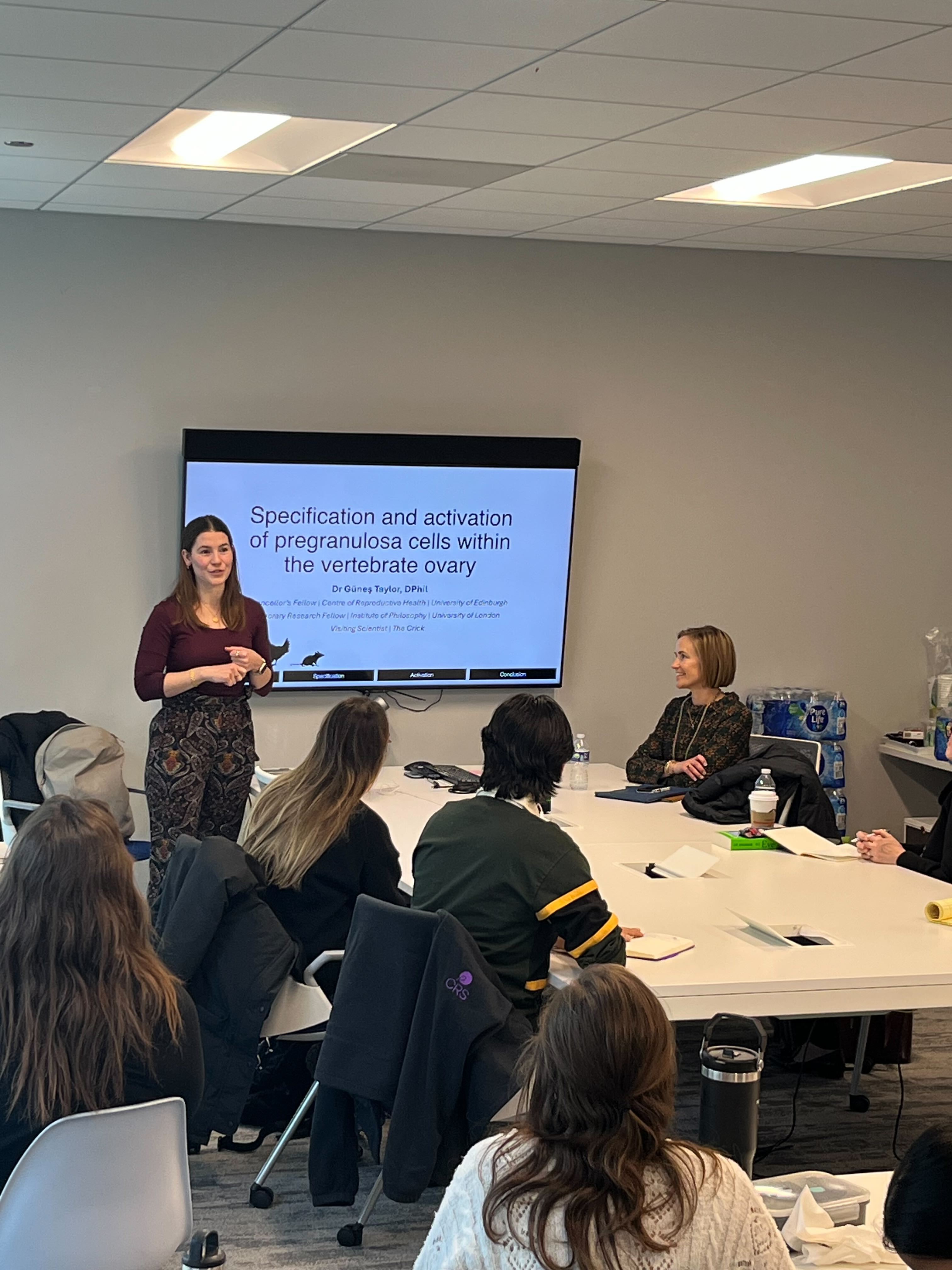
Dr. Güneş Taylor is a Chancellor’s Fellow within the Centre for Reproductive Health at the University of Edinburgh, a Trustee of the UK Genetics Society, and an award-winning science communicator and public speaker. She completed her DPhil at the University of Oxford under the mentorship of Prof. Tatjana Sauka-Spengler, where she studied gene regulatory networks in avian cranial neural crest cells. She then pursued postdoctoral training with Prof. Robin Lovell-Badge at The Francis Crick Institute, focusing on the specification of ovarian pre-granulosa cells in avian models and their activation in mice. Currently funded by the BBSRC and the Rosetrees Trust, Dr. Taylor leads an independent research program dedicated to advancing female health and fertility. Her work seeks to uncover the molecular mechanisms governing depletion of the finite ovarian follicle reserve, a process that culminates in menopause or, when accelerated, leads to premature ovarian failure and infertility.
A central theme of Dr. Taylor’s talk was the remarkable biology of pre-granulosa cells. These cells are specified very early during gonadal development and associate with oocytes to form primordial follicles. What makes them particularly fascinating is their longevity: in humans, pre-granulosa cells can remain quiescent for decades, maintaining their identity and function until they are called upon to support follicle activation. Despite this prolonged dormancy, pre-granulosa cells retain the ability to rapidly transition into an active granulosa cell state. This dual capacity long-term maintenance, combined with rapid activation, raises fundamental questions about how cellular identity, epigenetic memory, and gene regulatory networks are preserved over time.
Dr. Taylor highlighted the transcription factor FOXL2 as a key molecular player in pre-granulosa and granulosa cell biology. FOXL2 is one of the earliest markers of pre-granulosa cells and is essential for maintaining ovarian fate across vertebrate species. Its importance is underscored by the fact that loss or disruption of FOXL2 can lead to dramatic phenotypes, including sex reversal in several animal models and premature ovarian failure in humans, such as in Blepharophimosis-Ptosis-Epicanthus Inversus Syndrome (BPES). By examining FOXL2 within broader gene regulatory networks, Dr. Taylor’s work sheds light on how ovarian identity is actively maintained rather than passively preserved.
Another major focus of the talk was primordial follicle activation, the process by which dormant follicles enter the growth phase. While essential for fertility, this process also drives the gradual depletion of the ovarian reserve. Once activated, follicles are irreversibly committed to growth or loss, making the regulation of this step critical for reproductive lifespan. Using amniote model systems, including avian and murine models, Dr. Taylor investigates how gene regulatory networks within pre-granulosa cells control this activation process. Her research aims to identify molecular pathways that could potentially be modulated to slow ovarian reserve depletion, with long-term implications for extending reproductive health and preventing premature infertility.
Dr. Taylor’s work bridges developmental biology, reproductive genetics, and translational fertility research. By elucidating how pre-granulosa cells are specified, maintained, and activated, her research provides foundational insights into the mechanisms underlying menopause and ovarian aging. Ultimately, this knowledge may inform future strategies to preserve fertility and improve outcomes for individuals at risk of premature ovarian failure.
Through her talk, Dr. Taylor emphasized that understanding ovarian biology is not only a question of basic science but also a critical step toward addressing unmet needs in female health and reproductive longevity.