CRS Scientist Spotlight on Claudia Stroupe
Claudia Stroupe is a PhD candidate in the Driskill Graduate Program under the mentorship of Dr. Thomas Hope. Her research focuses on understanding the relationship between Fc structural features and the ways that broadly neutralizing antibodies distribute in the body. She is also an alum of the MS-RSM program, class of 2022.
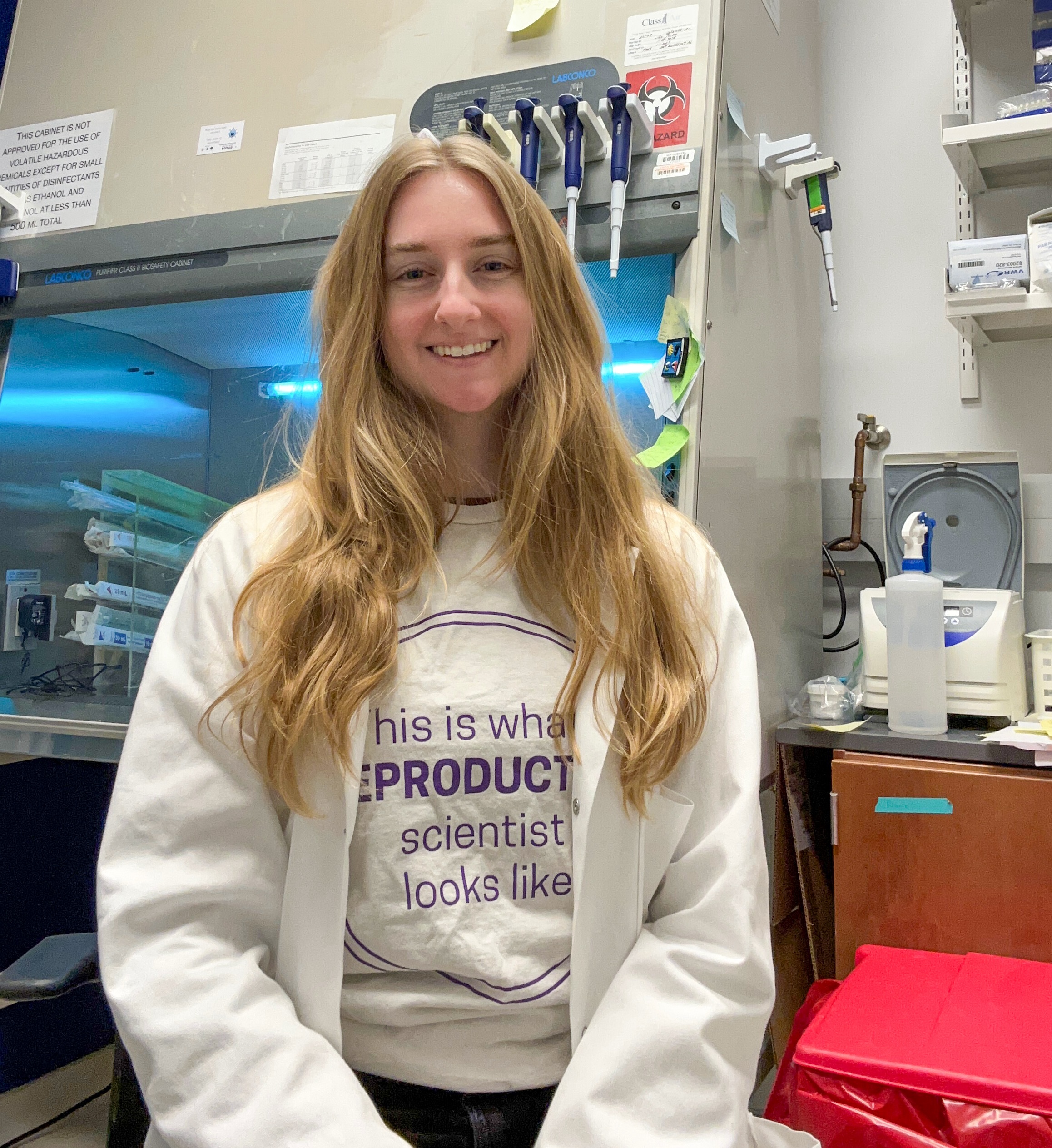
Thesis Mentor: Thomas Hope, PhD
Thesis Title: "Targeting Mucosal Immunity Through Fc-Engineered Broadly Neutralizing Antibodies"
What brought you to join the CRS community and what is your current position?
I first joined the CRS community in 2021 as a non-thesis master’s student in the Reproductive Science and Medicine program, where I studied the underlying causes of placental and maternal vascular dysfunction under the guidance of Dr. Pamela Monahan. I am currently a fourth-year PhD candidate in the Driskill Graduate Program under the mentorship of Dr. Thomas Hope.
Could you describe your research?
My thesis work is focused on understanding the relationship between Fc structural features and the ways that broadly neutralizing antibodies distribute in the body. The Fc region of IgG1 antibodies is responsible for binding to Fc gamma receptors found on the surface of immune cells, including natural killer cells, dendritic cells, and Kupfer cells. These cells are not found uniformly throughout the body, but instead reside at high densities within specific organs or tissue compartments.
We believe that by changing the structure of the Fc region through targeted Fc mutations or modification of N-glycans at Asn297, we can change the binding affinity of antibodies to these immune cells. In turn, this can influence whether antibodies are sequestered by immune cells in certain organs or are able to circulate more freely. Our overarching goal is to create an antibody that can preferentially target mucosal tissues like the female reproductive tract, rectum, and gastrointestinal tract to prevent sexual transmission and the early proliferation of HIV. So far, we have found that structural alterations can dramatically alter antibody biodistribution and have generated antibody variants that show increased persistence in either mucosal tissues or the blood.
What aspect(s) of CRS do you find most valuable?
The most valuable aspect of CRS for me has been the support and opportunities that come with being part of this community. During my time in the MS-RSM program, my mentors and professors consistently provided detailed feedback on how to improve both my science communication and experimental design. Similarly, as a PhD student, CRS has continued to provided opportunities to present my work and travel through programs and events including RRU, UMSRS, and the Constance Campbell Travel Award.
What has been the most valuable aspect to your training as a reproductive scientist?
The most valuable aspect of my training as a reproductive scientist has been learning how to communicate my work more clearly and improve my presentation skills. While this is still very much an ongoing process, I have found that explaining my work to a wide range of audiences has not only helped sharpen my presenting skills but has also allowed me to understand my project more deeply.
What is one piece of advice you would give to young scientists starting in their journey in science?
Do not compare yourself to others! Experimental and professional progress often happen unevenly, with big leaps occurring when you least expect it. Just keep at it! You cannot grow as a scientist if you are focused on how you measure up against others. I would also encourage students to read as widely as possible. You never know how a paper might intersect with your own work.
What do you think will be the next big contribution in the reproductive biology field?
I think that one of the most exciting contributions to the field is the growing understanding that the reproductive tract is a highly specialized immune environment, and that key reproductive process such as implantation and early pregnancy are, in many ways, immune-mediated events. Recently, I’ve come across several papers highlighting the importance of the immune endometrial environment in regulating endometrial receptivity and implantation success. One study in particular used endometrial immune profiling to guide precision therapy and reported significantly increased live birth rates following embryo transfer (https://doi.org/10.3389/fimmu.2025.1523871).
What hobbies do you have outside of the lab?
I love hiking, bird watching, biking along the lakefront trail, and hanging out with my beautiful 19-year-old cat, Emo AKA Lemur.