CRS Scientist Spotlight on Annapurna Sai Josyula
Annapurna (Anu) Sai Josyula is a 2nd year MS-RSM student. She conducted her thesis research with Dr. Daniela Matei and is now a research intern with Dr. Crismita Dmello.
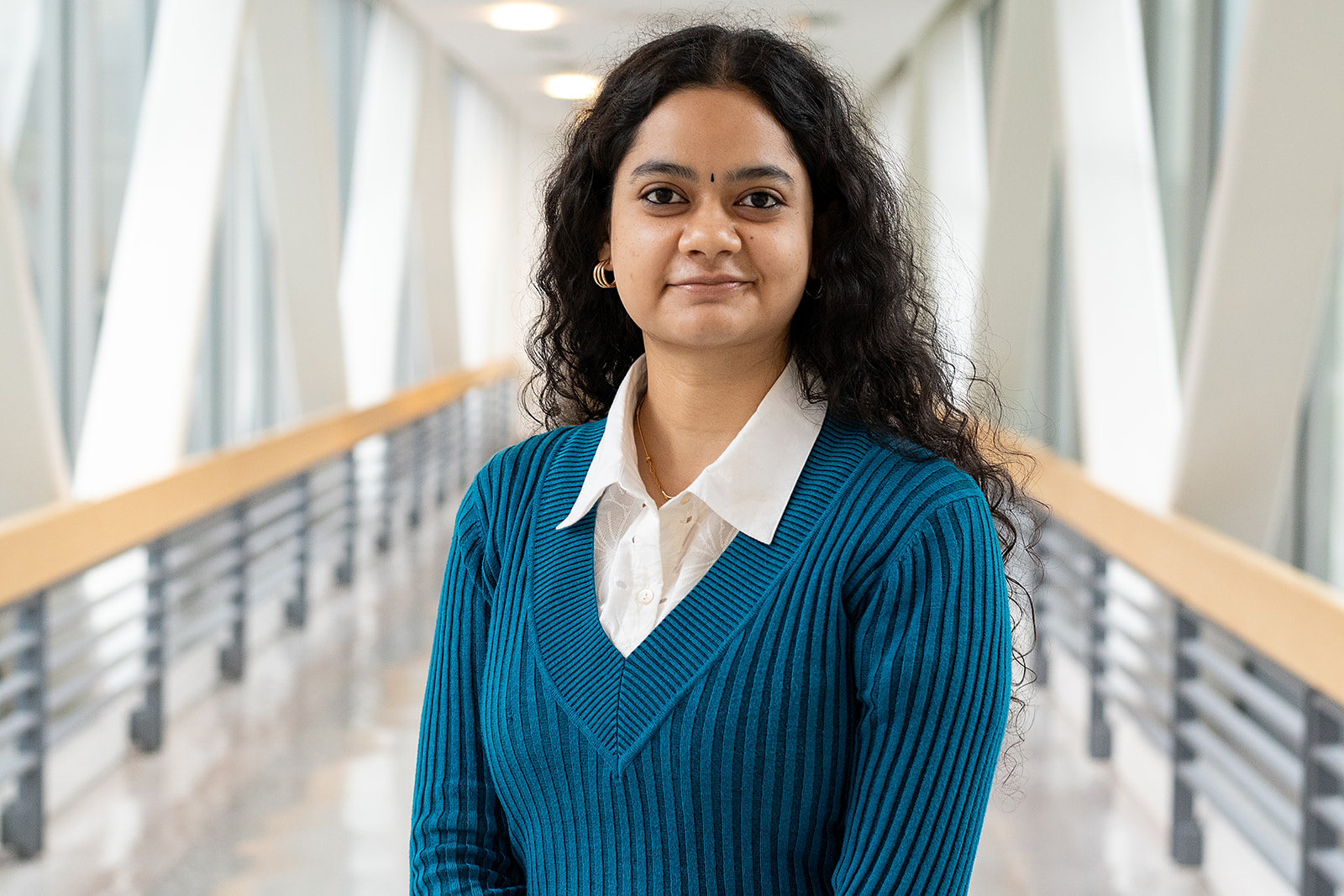
Thesis mentor: Daniela E. Matei, MD
Thesis title: "The Impact of Unsaturated Fatty Acids on Apoptosis and Endoplasmic Reticulum Stress in Ovarian Cancer: A Focus on Oleic Acid in Modulating Chemotherapy-Induced Stress and Chemosensitivity."
What brought you to join the CRS community, and what is your current position?
I was drawn to the Center for Reproductive Science because of its strong reputation for interdisciplinary research, collaborative culture, and commitment to advancing reproductive health through impactful science. The MS in Reproductive Science and Medicine program within CRS especially stood out to me as a unique opportunity to explore reproductive biology and gain valuable exposure to embryology. I looked at it as a perfect avenue where basic science and translational research work hand in hand to drive scientific advancement. I worked as a graduate researcher under the mentorship of Dr. Daniela Matei in the field of ovarian cancer biology for over 14 months. More recently, I chose to expand my horizons by joining the lab of Dr. Crismita Dmello in the Department of Neurosurgery. As a research intern in Dr. Dmello’s lab, I am studying the CHK2–YBX1 regulatory hub in glioblastoma and exploring its potential as a novel therapeutic target for improving treatment strategies.
Could you describe your research?
Biology is full of paradoxes, and what excites me most about research is trying to understand and challenge them. I have always been drawn to cancer biology because of the remarkable ways cancer cells adapt and thrive under stress, reflecting Charles Darwin’s idea that survival often favors adaptability. For my master’s thesis under the mentorship of Dr. Daniela Matei, I studied how fatty acids influence the fate of ovarian cancer cells under stress. More specifically, I explored whether certain unsaturated fatty acids simply serve as fuel or whether they actively help cancer cells survive challenging conditions such as nutrient deprivation and chemotherapy treatment. Both of these conditions increase endoplasmic reticulum stress, which became a central focus of my work. My thesis research found that among several unsaturated fatty acids we tested, oleic acid consistently helped ovarian cancer cells adapt and resist stress. It reduced endoplasmic reticulum stress responses, lowered apoptosis, and showed a modest trend toward decreased chemotherapy sensitivity. What fascinated me most was the idea that a common, non-essential fatty acid could influence how cancer cells survive treatment. These findings changed the way I think about cancer metabolism and survival strategies tumors use under stress. This project reminded me why I chose science: to ask difficult questions, uncover mechanisms that can lead to therapeutic advancements, and ultimately improve patient outcomes.
What aspect(s) of CRS do you find most valuable?
To me, the Center for Reproductive Science is truly my second home. It is a close-knit community of people who are curious, driven, and united by a shared vision to make meaningful contributions to reproductive science. What I value most is the culture of mentorship and genuine investment in trainees. Despite incredibly busy schedules, the leadership and faculty consistently make time to guide, encourage, and support students in ways that feel personal and sincere. That kind of commitment leaves a lasting impact. CRS also showed me that mentorship can come from every direction. My fellow master’s students, PhD students, and postdocs have all shaped my journey in different ways. They have been my peers, mentors, and at times, real north stars throughout graduate school. Another aspect I deeply value is how strongly CRS emphasizes science communication and critical thinking. It is a place where asking questions is encouraged, thoughtful discussion is valued, and learning extends beyond the classroom or benchside. It challenges you to think deeply and helps you grow into a more mature scientist. More than anything, CRS gave me a sense of belonging. It became a place where I could grow not only as a scientist but also as a person, both personally and professionally.
What has been the most valuable aspect of your training as a reproductive scientist?
The most valuable aspect of my training has been learning that troubleshooting technical difficulties is not simply about changing superficial parameters but about understanding the theory behind a technique and why it works. When challenges arise, it is important not only to question the method but sometimes to reframe the research question itself. That mindset taught me that meaningful progress in science often begins with asking better questions. My training has also taught me how to think scientifically: how to design experiments thoughtfully, interpret results critically, and stay curious even when answers are not immediate. Just as importantly, it has shown me the value of resilience, because growth in research often comes through troubleshooting, persistence, and learning from setbacks. It also taught me that negative results or unexpected trends should not be seen as stop signs but as opportunities to push boundaries, ask second-order questions, and remain open to the possibility that the cells may be telling a different story. I learned to follow the data honestly and understand where it leads, rather than trying to make it fit the story we planned. Overall, it helped shape me into a more independent and thoughtful researcher.
What is one piece of advice you would give to young scientists starting their journey in science?
I would say to find the questions that truly spark your curiosity. For me, questions like "Does it work?" “How does it work?” “Why does it work?” have always kept me motivated. Find the questions that stay in your mind and make you want to come back to the work with the same rigor every other day. There will be days when science goes your way, and there will be days when it challenges you. Both are part of the journey. Celebrate those highs, and in the lows, recognize that you may be uncovering something deeper and learning something important. As long as your foundation is strong, keep questioning and stay open to learning. Also, never hesitate to ask for help. Science research is rarely a solo journey, and some of the best growth comes from learning with others. Stay curious, stay persistent, and trust that if you keep showing up with sincerity, your moment to shine will come.
What do you think will be the next big contribution in the reproductive biology field?
I think the next big contributions to reproductive biology and medicine will come from several exciting directions. First, with advances in targeted drug delivery systems and subcutaneous implants, I can envision IVF treatments moving toward controlled and sustained hormone-release platforms that may reduce the need for multiple daily injections. That could lessen the physical discomfort and emotional burden on patients while also improving convenience, treatment adherence, and potentially overall outcomes. Second, growing insight into reproductive aging and changes within the ovarian microenvironment is helping us move toward more predictive and preventive care. These advances may lead to reliable models that better estimate ovarian response, embryo development potential, and implantation success, allowing treatment strategies to be tailored earlier and more effectively. Third, the integration of advanced 3D culture systems with patient-specific omics data could transform personalized reproductive medicine. By creating patient-relevant models, clinicians may be able to test which treatment combinations are most effective for an individual before making clinical decisions, leading to more precise and personalized interventions. I often think of medicine and research as the two blades of a pair of scissors. One focuses on direct patient care, while the other develops the knowledge and tools that make that care possible. Real progress happens when both work together.
What hobbies do you have outside of the lab?
Outside of the lab, I really value spending quality time with my friends, who mean a lot to me. I also enjoy going on long walks, as it helps me calm down, reset, and release some of that cortisol. The Chicago River and Lake Michigan are some of my favorite places to unwind. I am also a big foodie, so trying different cuisines and exploring new food spots is one of my favorite ways to keep my endorphins up.