CRS Scientist Spotlight on Evelynn Chen
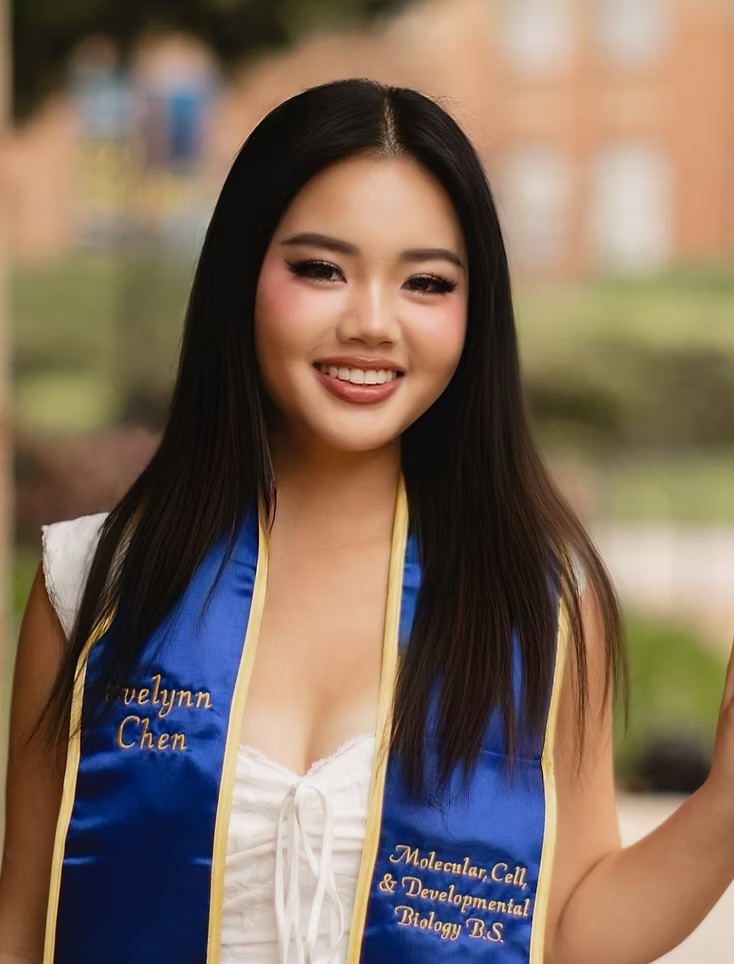
Evelynn Chen is a doctoral graduate student in the Laronda Lab. Her research investigates how the mechanical properties of the ovarian microenvironment influence follicle activation and granulosa cell function.
What brought you to join the CRS community and what is your current position?
I joined the CRS community because of my interest in reproductive biology and the opportunity to connect with scientists working across different areas of reproductive health and biology. As a graduate student, I’ve really valued being part of a community where I can learn from researchers with different perspectives and approaches to reproductive science. I am currently a PhD candidate in the Driskill Graduate Program in Life Sciences at Northwestern University Feinberg School of Medicine, where I work in the Laronda Lab.
Could you describe your research?
My research investigates how the mechanical properties of the ovarian microenvironment influence follicle activation and granulosa cell function. The ovary is a mechanically complex tissue, and the extracellular matrix surrounding follicles changes as follicles develop. I’m particularly interested in how cells sense and respond to these mechanical cues, and how those signals ultimately shape their behavior. Using bovine ovarian tissue and granulosa cell culture models, I study how changes in tissue stiffness and physical constraints influence follicle activation, granulosa cell nuclear architecture, and steroidogenesis. More broadly, I’m interested in understanding the connection between the mechanical environment of a cell and what happens inside its nucleus, and how these physical changes can ultimately influence reproductive function.
What aspect(s) of CRS do you find most valuable?
The sense of community! Reproductive science is inherently interdisciplinary, and CRS brings together people studying everything from reproductive endocrinology and ovarian biology to fertility, development, and reproductive health. As a trainee, I especially appreciate the opportunities to meet other students and scientists, share research, and learn about questions outside of my immediate area of expertise. Those interactions have helped me think about my own research from different perspectives and see how it fits into the broader field of reproductive science.
What has been the most valuable aspect to your training as a reproductive scientist?
The most valuable part has been learning how to approach biological questions from multiple perspectives. My research sits at the intersection of reproductive biology, biomechanics, and nuclear organization, so I’ve had to learn techniques and concepts that span several fields. I’ve also really valued the mentorship and collaborative environment I’ve encountered throughout my training. Working with people who approach similar biological questions differently has taught me that there is rarely just one way to answer a scientific question.
What is one piece of advice you would give to young scientists starting in their journey in science?
Be curious, ask questions, and find people who make you excited to learn. Science involves constantly learning, and no one is expected to have all the answers. I’ve found that some of the most valuable learning experiences have come from asking questions, talking through problems with other scientists, and being willing to try something new.
What do you think will be the next big contribution in the reproductive biology field?
Non-hormonal and male contraceptives.
What hobbies do you have outside of the lab?
I love listening to true crime podcasts, traveling, shopping, and, more recently, perfecting my matcha latte recipe!