CRS Scientist Spotlight on Andi Beaudouin
I would encourage junior scientists to remember that growth in science is rarely linear.
Andi Beaudouin
2nd Year MS-RSM Student, Torchen lab
Andi Beaudouin is a 2nd year thesis track student, completing the MS-RSM/MA-MHB dual degree program. They are conducting their thesis research with Dr. Laura Torchen, studying early-life determinants of reproductive and metabolic health, particularly the developmental origins of polycystic ovary syndrome.
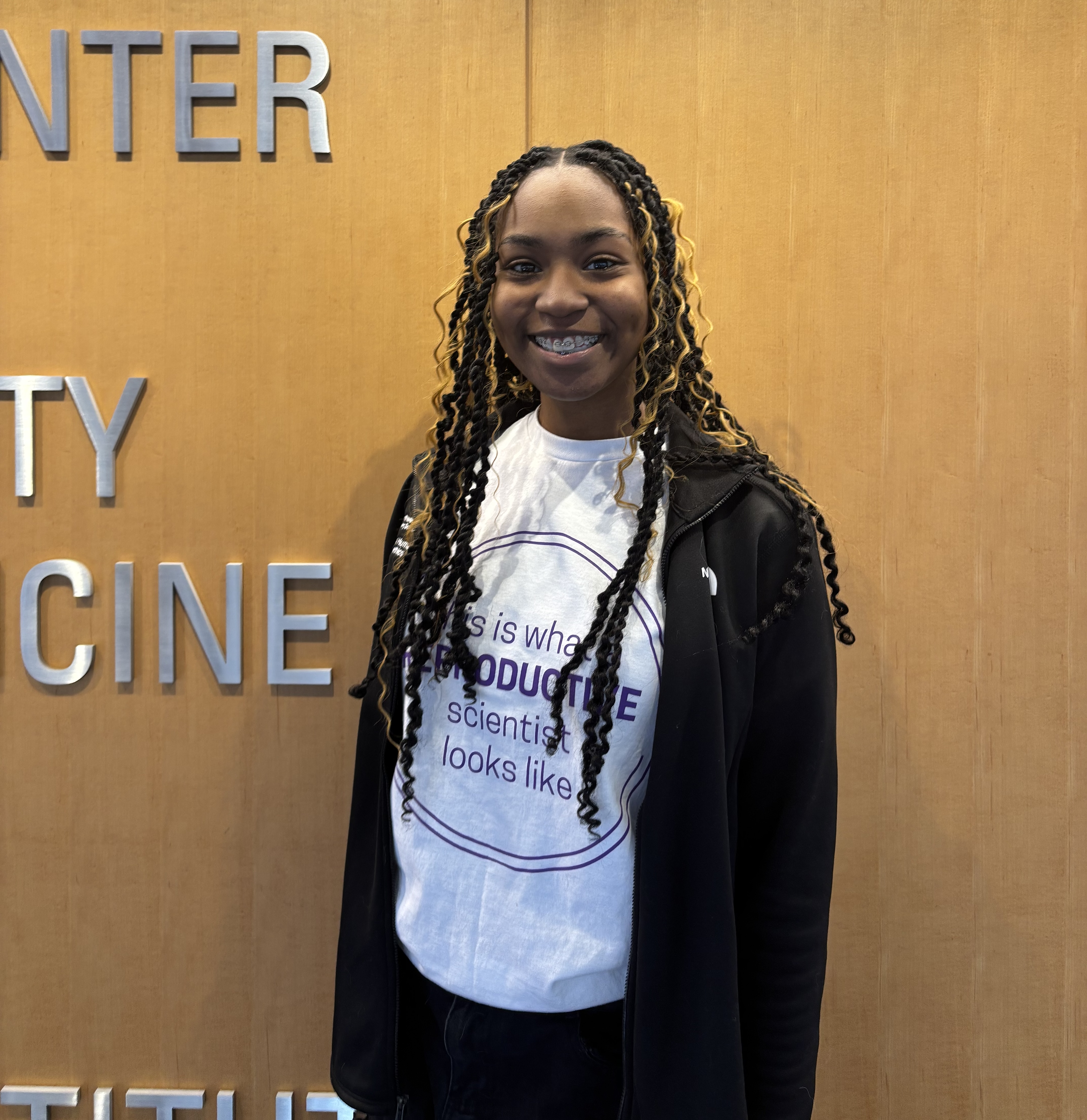
Mentor: Laura Torchen, MD, MSCI
Project Title: "Got Milk?: Exploring Developmental Origins of Polycystic Ovary Syndrome
Through Human Milk Biology"
What is your connection to the CRS community (mentor and position) and what is your
current position?
I am a second-year student on the thesis track of the Northwestern University Master of Science in Reproductive Science and Medicine (MS-RSM) program and the Medical Humanities and Bioethics (MA-MHB) program, and a member of the Center for Reproductive Science community. My research training has been conducted under the mentorship of Dr. Laura Torchen in the Endocrinology Division at Ann & Robert H. Lurie Children’s Hospital of Chicago. Within CRS, I am a member of the CRS Community Engagement Subcommittee and contribute as a writer on the CRS editorial committee. Through these roles, I have been actively involved in scientific programming, communication, and community outreach related to reproductive science.
My current work focuses on translational research examining early-life determinants of reproductive and metabolic health, particularly the developmental origins of polycystic ovary syndrome. Through my research and leadership activities within CRS, I have been able to engage with an interdisciplinary community of scientists, clinicians, and trainees who are advancing reproductive biology across many domains.
Could you describe your current research/studies?
My research focuses on the developmental origins of polycystic ovary syndrome (PCOS). PCOS is one of the most common endocrine disorders affecting people with ovaries, yet the early life factors that may contribute to risk are still not well understood. Most research focuses on treatment and symptom management rather than on understanding the pathophysiology. For my thesis, I examined how maternal metabolic and endocrine profiles influence human milk composition and how these early nutritional exposures relate to infant growth trajectories. This work involved analyzing breast milk macronutrients and hormones, including insulin and leptin, and integrating these measurements with infant anthropometric data to explore how maternal physiology may shape early metabolic programming. The goal of this research is to better understand how endocrine risk may emerge early in life and how maternal and infant physiology interact across generations. Ultimately, identifying early biological signals may help inform prevention strategies and improve reproductive and metabolic health outcomes.
What aspect(s) of CRS did you find most valuable?
CRS is full of learning opportunities. Even scientists who are leaders in their fields can learn something new from colleagues working in different areas of reproductive science. One of my committee members is an expert in PCOS, but did not know much about breast milk biology, so it was amazing for me to be able to teach a professor something new! That culture of intellectual curiosity and collaboration makes the community incredibly dynamic and encourages trainees to think broadly about scientific questions.
CRS also provides a wide range of opportunities for professional and scientific development. During my time in the program, I was able to participate in the Enriching Communication Skills for Health Professionals (ECHO) training program, which strengthened my ability to communicate complex scientific concepts in clinical and community settings. Through CRS connections, I also began advocacy-focused research with the urology department at Lurie Children’s Hospital. Experiences like these allowed me to expand my training beyond the laboratory and think about how reproductive science intersects with patient care, policy, and public health.
What has been the most valuable aspect to your training as a reproductive scientist in CRS?
One of the most valuable aspects of my training has been the opportunity to bridge the gap between clinical care and basic science research. Being able to connect what happens during clinic visits with the biological questions we study in the laboratory has helped me keep the broader impact of research in perspective. It is a powerful reminder that the data we analyze ultimately relates to real patients, families, and long-term health outcomes. This interdisciplinary approach has shaped how I think about reproductive biology and how scientific discoveries can ultimately improve patient care.
Working in a translational research environment has also allowed me to see how a scientific question develops from beginning to end. From identifying a clinical observation to designing a study, collecting and analyzing data, and ultimately interpreting the findings, it has been incredibly exciting to participate in the full research process. Being able to tell that research story from start to finish has been one of the most meaningful parts of my training and has shaped how I approach scientific questions and communicate with others as a reproductive scientist.
What would you recommend to junior scientists in order for them to succeed in their scientific
careers?
I would encourage junior scientists to remember that growth in science is rarely linear. There will be moments of uncertainty, challenges, and discomfort, but those experiences are often where the most meaningful learning happens. Being willing to step outside of your comfort zone and embrace that process is an important part of developing as a scientist. I also encourage trainees to take advantage of opportunities that come their way, even if they do not feel like experts right away. Many of the most valuable experiences in my training came from saying yes to opportunities that initially felt unfamiliar, whether it was presenting research, joining new collaborations, or engaging in community and advocacy work. Over time, those experiences build both confidence and skill.
Another important lesson I have learned is that there are no dumb questions in science. At one of the CRS Reproductive Research Updates seminars, I asked a question that I initially thought might be trivial. The presenter responded that they had never considered that perspective before and that it was something they would look into further. That moment reminded me that questions, even simple ones, can introduce new ways of thinking about a problem. Science advances through curiosity and dialogue, and sometimes a fresh perspective can open the door to new ideas.
Finally, I believe it is important to approach science with the mindset of being the change you wish to see. Scientific progress depends on people who are willing to ask new questions, challenge assumptions, and advocate for thoughtful and inclusive research practices. Staying curious, engaged, and open to growth can make a meaningful difference both in your own career and in the field as a whole.
What do you think will be the next big contribution in the reproductive biology field?
I believe some of the most important future contributions in reproductive biology will involve developing a true cure for endometriosis and gaining a deeper understanding of the underlying etiology of polycystic ovary syndrome (PCOS). Both conditions affect millions of individuals worldwide, yet many aspects of their biological mechanisms remain poorly understood. Endometriosis continues to be associated with delayed diagnosis and limited treatment options, and identifying the mechanisms that drive disease progression could ultimately lead to curative therapies rather than symptom management. Similarly, PCOS is one of the most common endocrine disorders affecting reproductive-aged individuals, but its origins are complex and likely involve interactions between genetics, metabolism, and early developmental factors. Advancing our understanding of PCOS etiology could help researchers identify earlier biomarkers of risk and develop more targeted prevention and treatment strategies. Progress in these areas would have profound implications for reproductive health, metabolic health, and overall quality of life for many patients.
Do you have any notable stories from your time in CRS?
One of my favorite memories from my time working on our study involved collecting infant anthropometric measurements during a visit. At one point while I was measuring a baby, they unexpectedly kicked me right in the face. The parents were incredibly apologetic, but I thought it was hilarious. Moments like that remind you that research involving babies can be unpredictable. By the end of the visit, things had completely turned around. We started playing some songs from Bluey and K-Pop Demon Hunters, and the baby quickly warmed up to me. By the time we finished the measurements, the baby was holding my hand and did not want me to leave. It was such a funny and sweet moment, and it really highlights how human and personal clinical research can be. Working with families and seeing those interactions firsthand makes the research experience incredibly memorable.