Dr. Andrew Kelleher Delivers the CRS New Year’s Lecture
Andrew Kelleher, PhD, was the speaker for Northwestern’s Center for Reproductive Science (CRS) 2026 New Year’s Lecture, held on January 23, 2026. Dr. Kelleher earned his PhD at the University of Missouri and completed his postdoctoral training at UT Southwestern Medical Center. Currently, Dr. Kelleher is an assistant professor at the University of Missouri and NextGen Precision Health Investigator. His research focuses on understanding the physiological and genetic mechanisms underlying uterine development and function. 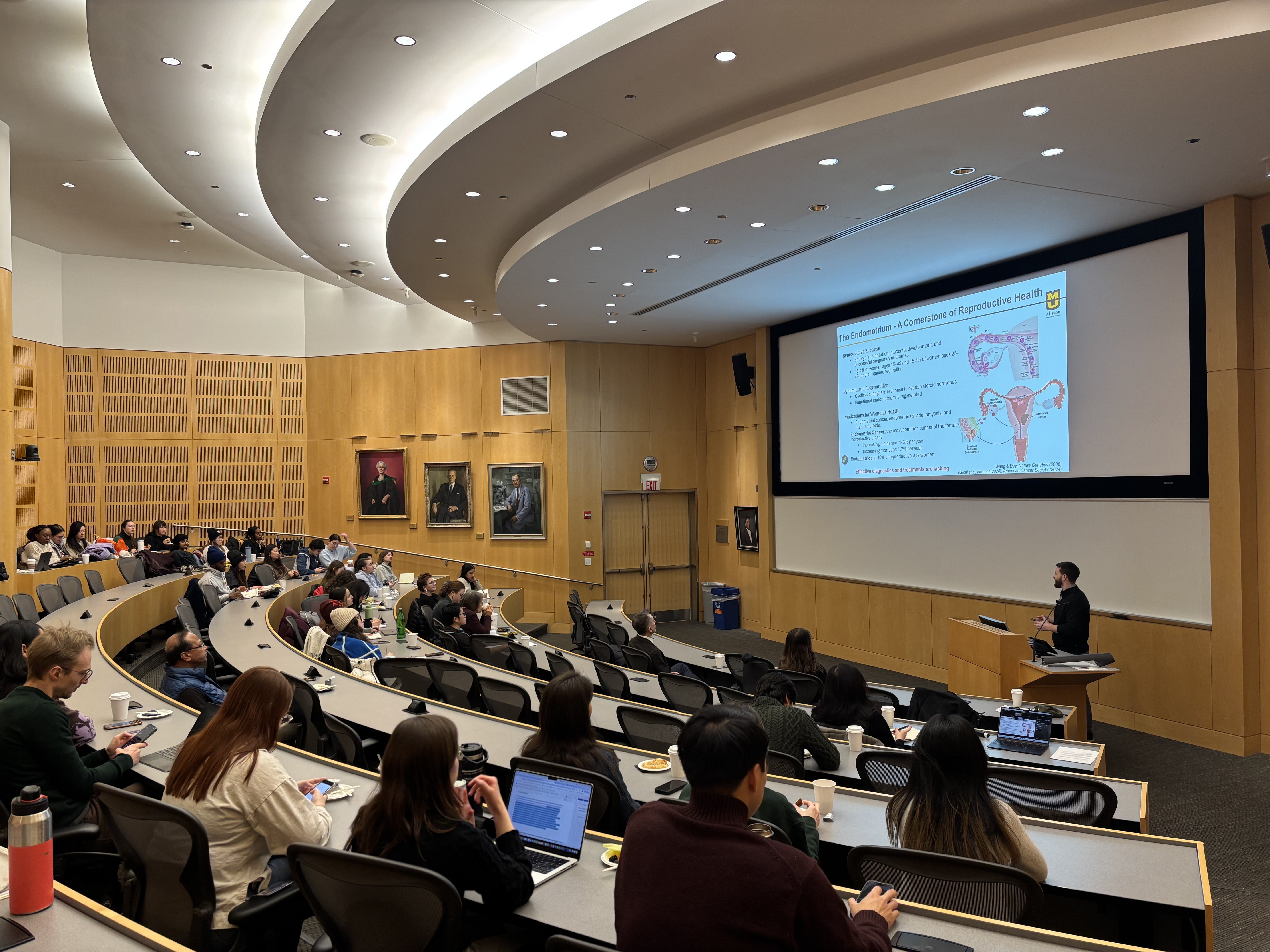
Dr. Kelleher emphasized the importance of the uterus, and how dysfunction within this highly dynamic organ can lead to disease states such as endometrial cancer and endometriosis. Additionally, diseases like endometriosis can take years for proper diagnosis, highlighting the importance of understanding the endometrium to guide future diagnostic and therapeutic strategies for patients.
His talk centered on his group’s recent paper, “Uterine organoids reveal insights into epithelial specification and plasticity in development and disease”, where his lab observed how fetal-like transcriptional states reemerge in regeneration and tumor progression of endometrial tissue. This work aims to address gaps in knowledge of how female reproductive tract epithelial cell fates are determined using organoids and assembled models, along with genetic analyses.
Using mouse neonatal uterine organoids, Dr. Kelleher’s group detected diversity in organoid development into either single-layered columnar or multi-layered stratified squamous structures. Further, the developmental plasticity of the uterine epithelium to develop multilayer structures declined with age. With this finding, Dr. Kelleher’s group shifted to looking at how the uterine epithelial specification can be mesenchyme-driven. Using genetic analyses, they were able to observe that uterine mesenchymal-to-epithelial cell signaling during mouse neonatal development was able to drive epithelial cell fate. Notably, TGFB signaling was found to regulate cell specification, and dysregulation of this signaling can lead to uterine cancer.
Dr. Kelleher magnified the relevance of these findings to human disease as multilayered uterine epithelial organoids observed resemble epithelial features seen in endometrial cancer patient organoids. The organoids reflect abnormal differentiation marked by increased cellular plasticity and the presence of basal-like cell populations that are not typically found in the healthy adult uterus. The study supports the hypothesis that developmental programs active in early life may be reactivated or dysregulated during endometrial disease.
The talk was concluded by Dr. Kelleher stressing the value of understanding epithelial cell dynamics and utility of neonatal endometrial epithelial organoids. By linking uterine developmental plasticity to endometrial disease states, Dr. Kelleher underscores the potential in utilizing developmental biology–informed approaches to develop targeted treatments for reproductive diseases.