CRS Lab Spotlight on the Laronda Lab
For this month's Lab Spotlight, we are taking a closer look at the research questions and people behind the successes of the Laronda Lab, a familiar name across the Center for Reproductive Science. Led by Dr. Monica Laronda, the George M. Eisenberg Chair of Developmental Biology at the Stanley Manne Children's Research Institute at Ann & Robert H. Lurie Children's Hospital and Associate Professor in the Department of Pediatrics and Department of Obstetrics and Gynecology at Northwestern University, the lab is highly interdisciplinary, bridging human reproductive biology, biomedical engineering, and endocrinology insights. The Laronda Lab's mission statement captures this direction clearly as they "seek to understand mechanisms of human sex development and to translate this knowledge into solutions that support fertility and hormone diagnostic and restorative technologies." 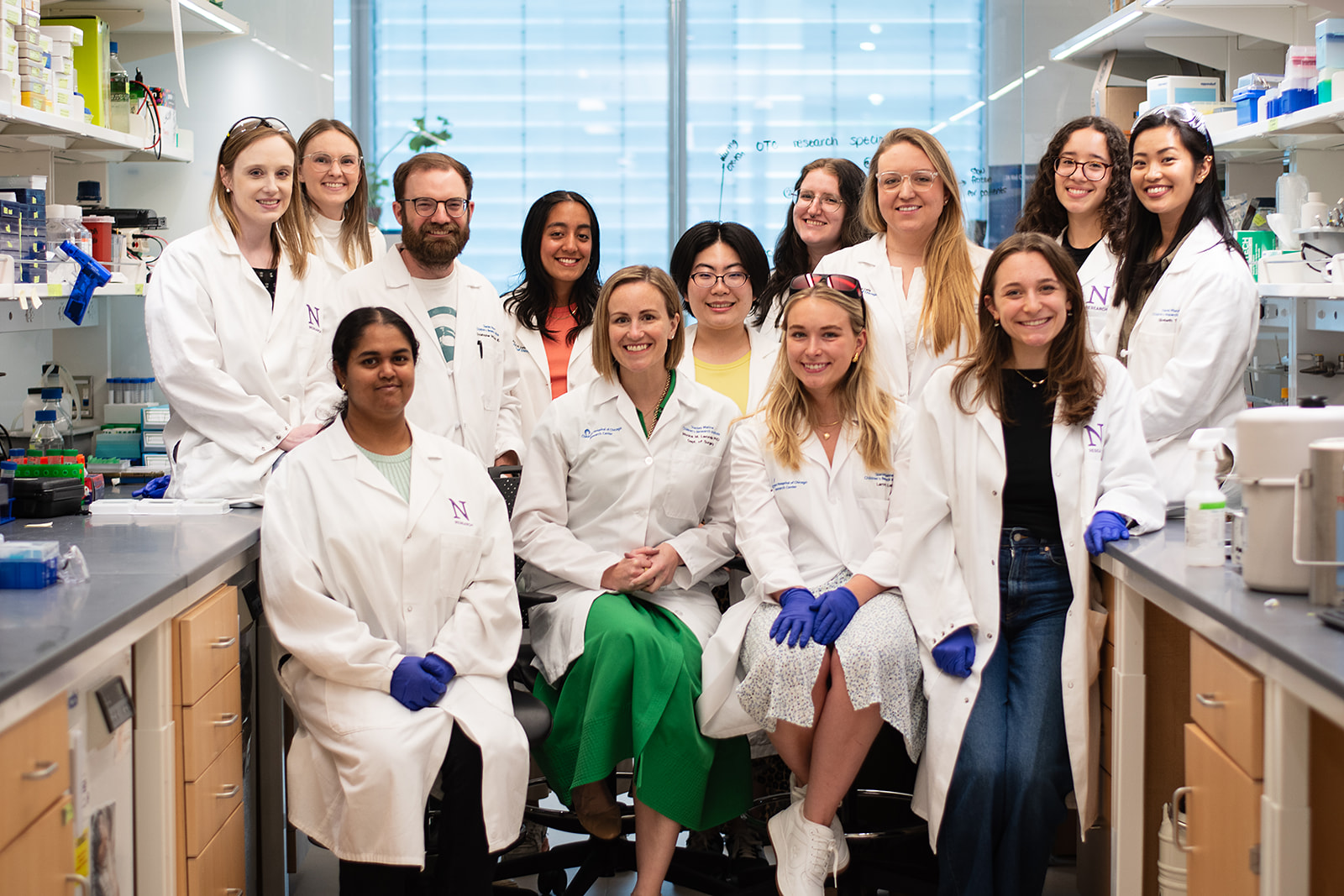
The Laronda Lab includes a collaborative group of trainees and staff across levels, including Research Assistant Professor Dr. Diane Saunders, alongside postdoctoral and graduate researchers, master's students, and lab technicians who contribute to the lab's efforts. In practice, the lab centers on human reproductive and developmental biology mechanisms that are difficult to resolve in animal models or simplified culture systems. They pair these questions with various human and model tissues, biomaterials, and engineered models that allow for rigorous testing, while keeping the research aligned with translational goals.
The ovary and the environment that supports follicle development are central to the Laronda Lab. The group studies the ovarian extracellular matrix (ECM) as a source of biological and physical cues that influence follicle behavior, including how tissue stiffness and differences between ovarian compartments such as the cortex and medulla may affect follicle activation. PhD student Evelynn Chen's research exemplifies this approach as she “investigates how the physical and cellular microenvironment of the ovary regulates primordial follicle activation, with a focus on mechanical forces, ECM structure, and granulosa cell morphology.” To study these processes directly, the lab develops hydrogels and other biomaterial systems to model the ovarian ECM, recreating important aspects of the ovarian environment.
The lab is also interested in understanding the testicular microenvironment and in restoring spermatogenesis. PhD student Brianna Thompson is building testicular assembloids to create a more realistic human testis model. In the long term, this testis model has the potential to improve how we study and develop in vitro spermatogenesis.
In addition to the lab’s studies on reproductive microenvironments, the Laronda Lab uses stem cell models to investigate gonadal development and function. They have developed protocols to generate granulosa-like cells from human induced pluripotent stem cells (iPSCs), creating a model to test what granulosa cells require to mature and how different ECM coatings or culture environments could shape granulosa cell growth and behavior.
Many of the lab's questions connect directly to patient care, which is made possible by the availability of human tissue through organizations such as Gift of Hope. As Hannah McDowell, a PhD student in the lab, notes, "I love being in the Laronda Lab because we have access to human ovarian tissue from across the lifespan, which is very rare and very special. With this unique resource, we're able to ask amazing translational questions." Access to human tissue resources supports a range of projects across the lab. One research project investigates how chemotherapy affects the ovary, with the goal of improving fertility preservation strategies and protecting ovarian function for patients who need life-saving therapies. Additionally, the lab utilizes these tissues to study differences in sex development (DSD), allowing the team to examine sex developmental biology in patient groups that remain understudied in research.
Finally, the lab's collaboration with the Fertility and Hormone Preservation and Restoration Program at Lurie Children's, with Dr. Laronda as Director of Gonadal Tissue Processing, provides a unique window into clinical practice and the future needs of patients. Through this program, patients facing cancer treatment or other gonadotoxic therapies can have ovarian or testicular tissue cryopreserved, offering the possibility of future fertility restoration. This collaboration keeps the lab closely connected to patient care, informing research priorities and helping translate findings into clinical practice. As research technologist Maya VanZanten describes, "My favorite part about being in the Laronda Lab is that our work uniquely bridges the gap between basic science and the clinic. Not only do I get to participate in the development of novel fertility and hormone restoration technologies, but I also get to make a direct impact on patients through performing ovarian and gonadal tissue cryopreservation."
The Laronda Lab shows what's possible when reproductive science, bioengineering, and clinical care come together. Through innovative models and unique human tissue resources, their projects continue to push the boundaries of reproductive research and fertility preservation. Their efforts contribute to a future where more patients have access to effective reproductive and hormonal therapies.